A team I advise spent three months migrating their Java microservices to Graviton3. They finished in November 2025. Two weeks later, AWS announced Graviton4 with 30% better compute performance. Their reaction was predictable. But when we looked at the numbers, the real optimization opportunity wasn’t the chip upgrade at all. It was the combination of Lambda Managed Instances for their high-throughput API and S3 Express One Zone for their ML training pipeline. The chip matters less than the architectural fit.
AWS optimization in 2026 isn’t about picking the cheapest instance anymore. The new generation of services creates genuinely different cost profiles depending on workload characteristics. Graviton4 extends ARM’s lead for sustained compute. Lambda Managed Instances blur the line between serverless and provisioned. S3 Express One Zone changes the economics of data-intensive workloads. Understanding when each applies, and when it doesn’t, is where real savings materialize.
Graviton4: The 8g Generation Arrives
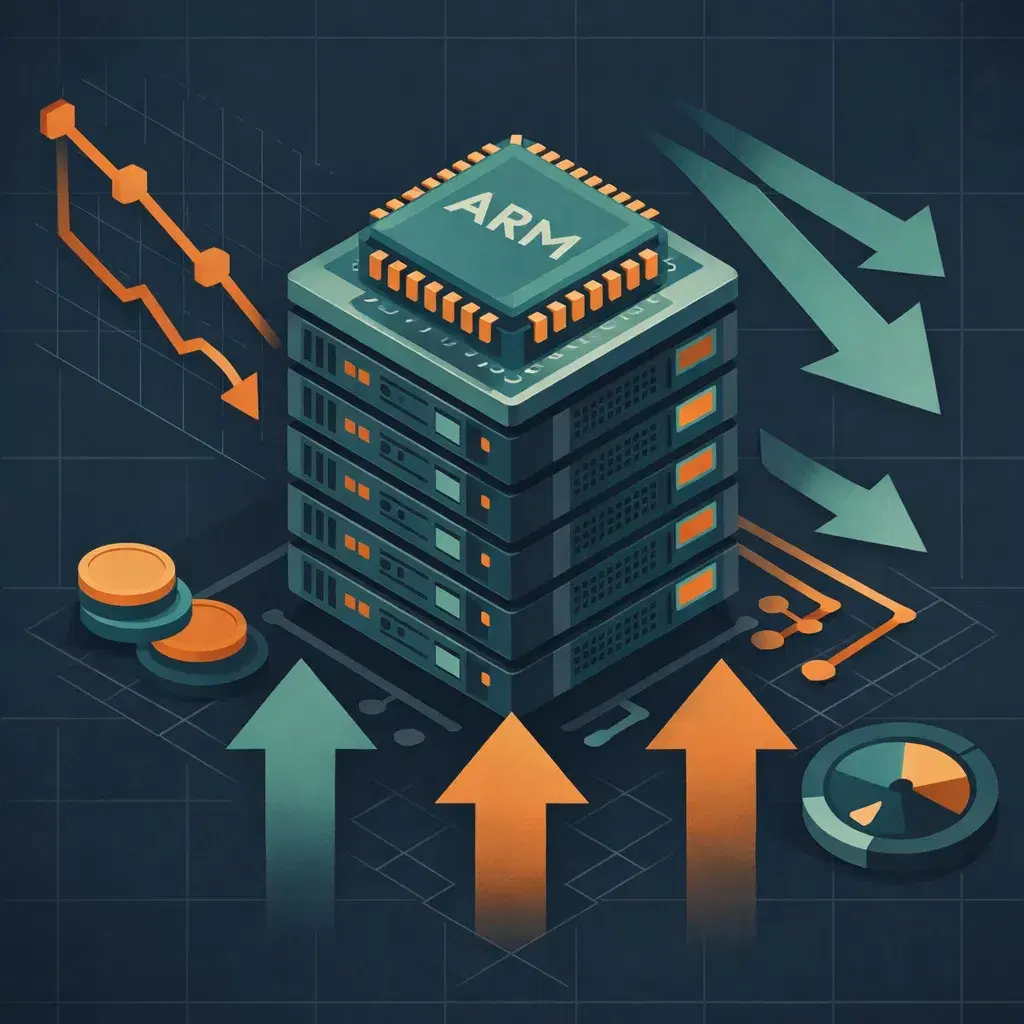
Graviton4 powers the new 8g instance families – M8g, C8g, R8g, and X8g – delivering up to 30% better compute performance over Graviton3’s 7g generation. All variants ship with DDR5-5600 memory, always-on memory encryption, and dedicated caches per vCPU. The network-optimized variants (C8gn, R8gn) push up to 600 Gbps bandwidth, the highest among any EC2 instance type. The EBS-optimized variants hit 300 Gbps bandwidth with 1.44 million IOPS.
The X8g family stands out for memory-intensive workloads. With up to 3TB of memory and 60% better performance than X2gd, it targets in-memory databases like Valkey and Redis, relational databases running large working sets, and EDA workloads. At the lowest cost per GiB of memory in the Graviton4 lineup, X8g makes previously GPU-territory workloads viable on general-purpose compute.
The pricing advantage remains structural: Graviton instances cost roughly 20% less than comparable x86 instances while consuming up to 60% less energy. Over 90,000 AWS customers now run on Graviton, which means ecosystem support – container images, language runtimes, third-party software – is no longer the friction point it was two years ago.
When Graviton4 Matters Most
The 30% compute improvement sounds compelling, but the migration cost from Graviton3 to Graviton4 is minimal compared to x86-to-ARM migrations. If you’re already on Graviton3, the upgrade is straightforward – same ARM architecture, same container images, just a new instance family in your launch template. The real question is whether you’re still running x86 workloads that should have moved to ARM two generations ago.
Graviton4 makes the strongest case for workloads that are CPU-bound with sustained utilization: application servers, batch processing, CI/CD builds, and database compute. For bursty workloads with low average utilization, the instance type matters less than the pricing model – Compute Savings Plans with their 66% discount or EC2 Instance Savings Plans at up to 72% savings still dominate the cost equation.
Lambda Managed Instances: Serverless Meets Provisioned
Lambda Managed Instances represent a fundamental shift in how AWS positions serverless compute. Instead of the traditional one-invocation-per-environment model running on Firecracker microVMs, Lambda Managed Instances run your functions on current-generation EC2 instances (including Graviton4) with multi-concurrent execution. AWS handles the instance lifecycle, OS patching, runtime updates, routing, load balancing, and scaling. You get the operational simplicity of Lambda with EC2-class performance characteristics.
The pricing model reflects this hybrid positioning: $0.20 per million requests plus standard EC2 instance pricing plus a 15% management fee. Because the underlying compute is EC2, your existing Savings Plans and Reserved Instances apply to the compute portion. The default deployment spans three instances across availability zones for resilience.
The Cold Start Calculus Changes
The most significant implication is the elimination of cold starts for predictable workloads. Traditional Lambda’s cold start problem has improved substantially – SnapStart now supports Java 11+, Python 3.12+, and .NET 8+, delivering up to 10x faster startup for Java. But SnapStart carries constraints: it’s incompatible with Provisioned Concurrency, EFS, ephemeral storage over 512 MB, and container images.
Lambda Managed Instances sidestep these constraints entirely. Your function runs on always-warm EC2 instances, scaling based on CPU utilization rather than invocation count. For APIs handling hundreds of requests per second with consistent traffic patterns, the economics favor Managed Instances. For genuinely bursty workloads – event processing, webhook handlers, scheduled jobs – traditional Lambda with SnapStart remains more cost-effective because you only pay for actual execution time.
The decision framework comes down to traffic predictability. If your P95 concurrency is within 2x of your P50 concurrency, Lambda Managed Instances likely win on both cost and latency. If your P95 is 10x or more of your P50, traditional Lambda’s scale-to-zero model is still the better economic choice.
S3 Express One Zone: When Latency Is the Bottleneck
S3 Express One Zone delivers consistent single-digit millisecond access, up to 10x faster than S3 Standard, with throughput of 2 million requests per second. Request costs drop by up to 80% compared to S3 Standard. The trade-off is single-AZ deployment – you select a specific availability zone and co-locate your compute resources there.
This service uses directory buckets rather than standard general-purpose buckets, a distinction that matters for tooling and automation. Your existing S3 SDK calls work, but bucket creation, lifecycle policies, and cross-region replication operate differently.
Where S3 Express Changes the Architecture
The primary use cases are data-intensive compute: ML training dataset access, interactive analytics, HPC scratch storage, and media processing pipelines. For ML training specifically, the throughput improvement is transformative. Training jobs that previously spent 40% of GPU time waiting for data from S3 Standard can now keep accelerators fed continuously. When you’re paying $30+ per hour for GPU instances, eliminating I/O wait translates directly to reduced training costs.
S3 Tables adds another dimension for analytics workloads. As the first cloud object store with built-in Apache Iceberg support, it delivers 10x higher transactions per second compared to self-managed Iceberg tables on standard S3 buckets. Automatic compaction, z-order sorting, snapshot management, and unreferenced file removal happen without operational overhead. For data lake architectures queried through Athena, Redshift, or Spark, the performance improvement compounds with reduced operational complexity.
The single-AZ constraint means S3 Express One Zone isn’t a replacement for S3 Standard in durability-critical storage. Think of it as a high-performance compute-adjacent tier: training data, scratch space, intermediate results, and hot analytics data. Your canonical data stays in S3 Standard or S3 Intelligent-Tiering with cross-region replication.
The Cost Optimization Hub and Compute Optimizer
AWS has consolidated its optimization tooling into the Cost Optimization Hub, which aggregates recommendations across your organization. Compute Optimizer, the ML-powered rightsizing engine, now provides Graviton migration recommendations that identify workloads with the highest ROI for ARM migration and flags idle resources like unattached EBS volumes and underutilized EC2 instances.
Cost Anomaly Detection catches unusual spending patterns through ML-based analysis. Cost Categories enable custom resource grouping for allocation. These tools work best in combination – Compute Optimizer identifies what to change, Cost Optimization Hub prioritizes by impact, and Cost Anomaly Detection catches regressions.
The gap in AWS’s native tooling remains multi-service optimization. Compute Optimizer handles EC2, Auto Scaling, RDS, EBS, and Lambda individually, but it doesn’t model the system-level interactions. Moving a workload from Lambda to Lambda Managed Instances might reduce compute costs while increasing data transfer costs if the deployment topology changes. The Hub aggregates recommendations but doesn’t simulate compound effects.
Aurora DSQL and the Database Cost Equation
Amazon Aurora DSQL merits attention in any optimization discussion because it changes the database scaling cost curve. As a serverless distributed SQL database with active-active multi-region architecture, it offers a 99.99% single-region SLA and 99.999% multi-region SLA. Compute, reads, writes, and storage scale independently without sharding.
For applications currently running Aurora PostgreSQL with read replicas across regions, DSQL potentially simplifies the architecture while improving availability. The elimination of manual sharding and replica management reduces operational costs that don’t show up in the AWS bill but consume engineering time. Aurora Limitless Database addresses a different problem – horizontal write scaling within a single region through automated shard groups – so the choice depends on whether your bottleneck is cross-region consistency or single-region write throughput.
Building Your 2026 Optimization Strategy
The optimization opportunities break into three tiers based on implementation effort and impact.
Tier one requires minimal architectural change: upgrading Graviton3 instances to Graviton4 (same ARM images, new instance family), enabling SnapStart on Lambda functions running Java, Python, or .NET, and reviewing Savings Plans coverage against current usage. These are configuration changes with predictable payoff.
Tier two involves workload migration: moving x86 workloads to Graviton4, evaluating Lambda Managed Instances for high-concurrency APIs currently running on ECS or EKS, and adopting S3 Express One Zone for ML training data currently served from S3 Standard. Each requires testing and validation but follows established patterns.
Tier three is architectural: redesigning data pipelines around S3 Tables and Iceberg, evaluating Aurora DSQL for multi-region database architectures, and implementing intelligent prompt routing for AI inference workloads (which I’ll cover in a future post on AI system design). These changes deliver the largest savings but require the most careful evaluation.
The common thread across all three tiers is that optimization in 2026 is less about picking the cheapest resource and more about matching workload characteristics to the right service model. A Lambda function that costs $50/month isn’t worth optimizing regardless of the approach. An ECS service processing 10,000 requests per second on m6i instances might save 40% by moving to Lambda Managed Instances on Graviton4 – but only if the traffic pattern justifies always-on compute. The numbers always depend on context.