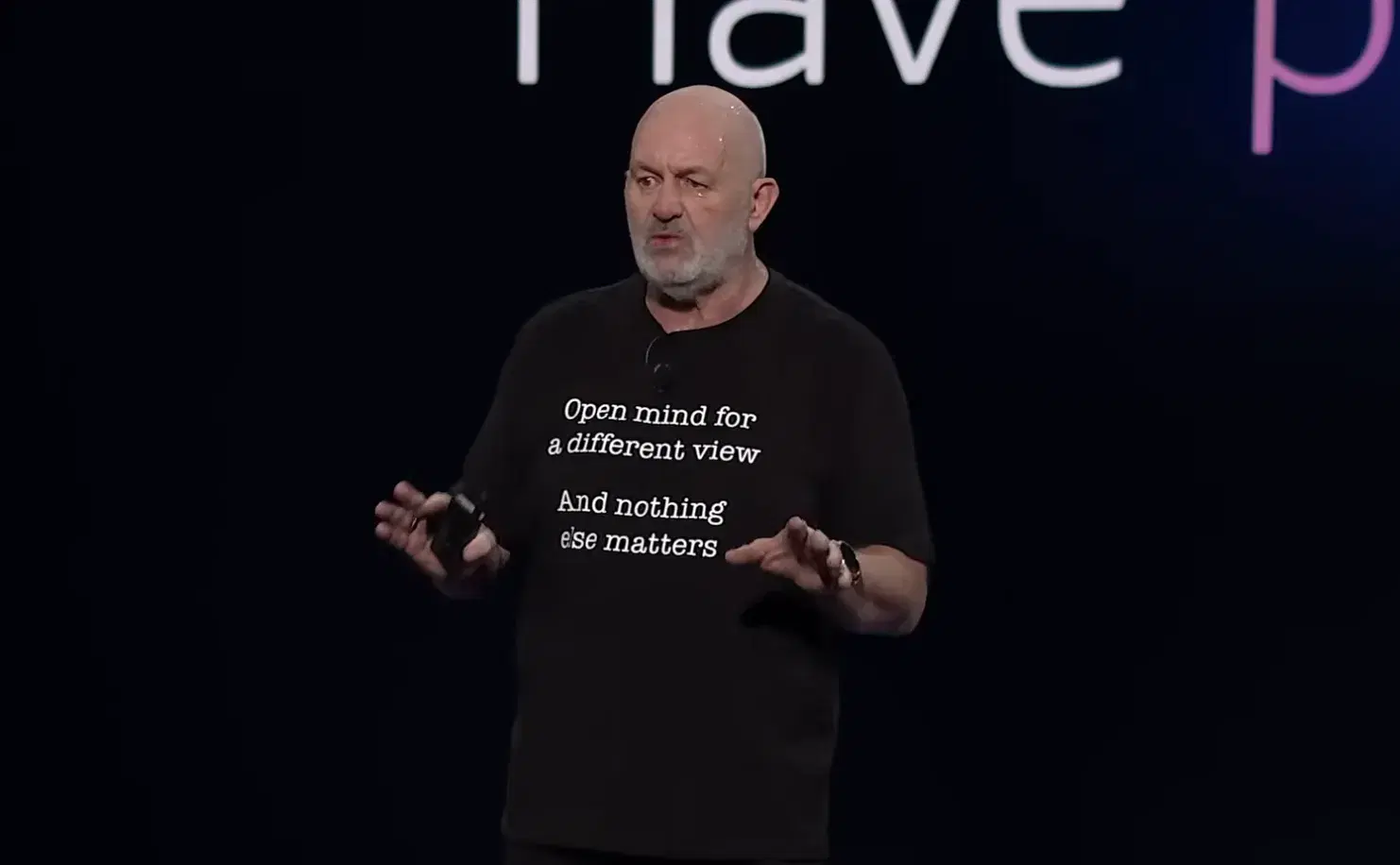
Werner Vogels stepped on stage for what he announced would be his final re:Invent keynote after roughly 14 years. After more than a decade of defining how AWS thinks about building software, he handed developers a framework for the next era: the Renaissance Developer.
The timing makes sense. AI coding assistants are everywhere. Developers are generating more code faster than ever. And the question Werner addressed directly is the one most developers are asking: “Will AI make me obsolete?”
His answer: absolutely not, if you evolve.
The keynote walked through six qualities that separate developers who thrive from those who struggle as AI reshapes the profession. Each quality comes with specific capabilities backed by examples from Werner’s travels, Amazon’s history, and the reality of building systems that millions of people depend on.
Why “Renaissance Developer”
Werner drew a parallel between now and the actual Renaissance in 15th-century Europe. The Renaissance followed the Dark Ages and the plague. It was a period when curiosity exploded, when scientists and artists broke down disciplinary boundaries, when new tools like the printing press, the telescope, and even the pencil fundamentally changed what people could create.
The analogy works. We’re at a similar inflection point where AI, robotics, and space technology are advancing simultaneously and reinforcing each other. Progress in one field accelerates progress in others. And like Renaissance thinkers who needed to adapt to dramatically new tools and possibilities, developers today face a similar transformation.
The six qualities Werner outlined adapt what made Renaissance thinkers effective: curiosity, experimentation, systems thinking, communication, ownership, and a broad base of knowledge combined with deep expertise.
Quality One: Curiosity and Continuous Learning
The obvious reality of software development is that everything changes constantly. Werner started programming with 68000 assembler, COBOL, and Pascal. None of those languages matter anymore. Compilers evolved from low-level abstractions to high-level ones. Structured programming emerged. Object-oriented programming took over. Services architectures replaced monoliths. Cloud infrastructure replaced on-premise data centers.
Each shift required developers to learn new paradigms, new tools, new ways of thinking.
AI coding assistants are the latest shift, and they won’t be the last. Curiosity is the trait that lets you stay relevant through these transitions. Developers who treat learning as a one-time event plateau quickly. Developers who stay curious about how things work, who take systems apart to understand them, who explore new approaches even when the old ones still function, keep growing.
Werner shared examples from his recent travels to Africa and Latin America. He referenced organizations like Grupo AJE, a beverage company supporting communities along the Amazon River, and Rwanda’s Ministry of Health, which has built a health intelligence center that uses near-real-time data from healthcare facilities to inform policy decisions like where to place maternal health clinics.
These weren’t Silicon Valley startups with unlimited budgets. They were organizations solving hard problems with limited resources by staying curious about what technology could do for them.
The practical takeaway: protect your instinct to understand how things work. Read code you didn’t write. Explore tools you don’t need yet. Ask why systems are designed a certain way. Curiosity compounds over time.
Quality Two: Experimentation and Willingness to Fail
Learning by reading only takes you so far. Real learning happens when you engage, when there’s pressure, when the outcome matters.
Werner referenced the Yerkes-Dodson law, which describes the relationship between stress and performance as a bell curve. Too little pressure and you disengage. Too much pressure and you’re overwhelmed. The sweet spot is the rising slope where curiosity meets challenge.
You reach that spot by experimenting, which means accepting that experiments fail.
Da Vinci modeled an airplane that never flew. The Apollo team relied on meticulous specifications, but those specs came from countless failed tests. Amazon broke its monolith into services through trial and error, not from a perfect blueprint.
The same principle applies to learning new tools. You can study AI coding assistant documentation endlessly, but you learn how these tools actually behave when your prompts fail, when the generated code doesn’t compile, when you realize the model hallucinated an API that doesn’t exist.
Werner’s advice: put yourself in positions that test you. Don’t sit comfortably. Learning is social too. Attend conferences, join user groups, have coffee with people building different kinds of systems. Touch the grass occasionally.
Quality Three: Systems Thinking
This quality separates developers who can build individual features from developers who can architect reliable systems.
Werner used the example of wolves in Yellowstone. In the early 20th century, wolves were removed from the park. The logic seemed sound: fewer predators meant more elk meant more life. The opposite happened. Elk overgrazed the valleys. Trees disappeared. Rivers began to erode.
When wolves were reintroduced in 1995-96, the park slowly healed. Vegetation returned. Beavers came back. Even rivers changed course. The wolves didn’t move the rivers directly. They changed the behavior of the overall system through what ecologists call a trophic cascade.
This is systems thinking: understanding that every part of a system affects other parts, often in non-obvious ways. Change a retry policy and you affect load. Add a cache and you change traffic flow. Shift team ownership and you change delivery pace.
Werner referenced Donella Meadows’ work on complex systems. She defined a system as “a set of things interconnected in such a way that they produce their own patterns of behavior over time.” Software systems absolutely fit this definition. They have lives of their own.
The practical application: when you make a change, think about second-order effects. What happens when this cache expires? How does this queue behave under backpressure? What are the failure modes? Systems thinking means understanding feedback loops, both reinforcing and balancing, and knowing where small changes can shift overall system behavior.
Werner recommended Meadows’ paper “Leverage Points: Places to Intervene in a System” as required reading. It’s homework worth doing.
Quality Four: Communication
The ability to express your thinking clearly is as critical as the thinking itself.
Werner showed an example from his “Frugal Architect” framework. He explained how Amazon’s homepage is divided into three tiers based on criticality. Tier one: search, browse, cart, checkout, reviews. Without those, the site doesn’t work. Tier two: personalization, recommendations. Important but the site functions without them. Tier three: nice-to-have features.
This becomes a communication tool for business discussions. You sit with business stakeholders and discuss availability targets. Four nines for tier one costs this much. Three nines for tier two costs that much. Two nines for tier three with manual failover if needed.
Clear communication lets you have productive conversations about trade-offs instead of technical arguments that business leaders can’t follow.
The keynote featured Clare Liguori, Senior Principal Software Engineer at AWS working on the Kiro team, who talked about specifications as a way to reduce ambiguity when communicating with AI. Natural language is ambiguous. Programming languages were precise. Now we’re communicating with machines through natural language again, which creates problems.
Clare noticed that as she used AI coding assistants more, she spent increasing time trying to describe what she wanted. The code looked good, but the software didn’t do what she intended. She started writing longer, more detailed prompts in markdown before pasting them into coding assistants. She was essentially creating specifications.
This led to spec-driven development in Kiro: requirements, designs, and tasks that let developers refine what they mean before AI generates code. The spec process helped the team catch overengineered solutions early, iterate on designs before implementation, and communicate precisely with AI tools.
The broader point: communication skills matter more, not less, in an AI-assisted world. You need to communicate with machines through precise specifications. You need to communicate with humans about system behavior, trade-offs, and risks. Practice both.
Quality Five: Ownership and Quality
AI lets you build faster. You write less code because generation is instant. You review more code because understanding takes time. When you write code yourself, comprehension comes with creation. When a machine writes it, you rebuild comprehension during review.
Werner called this “verification debt.” It’s one of two main challenges developers face with AI-assisted coding. AI generates code faster than you can understand it. Code arrives instantly, but comprehension does not. That gap allows software to move toward production before anyone validates what it actually does.
The second challenge is hallucination. Models generate plausible-looking code that’s completely wrong. They invent APIs that don’t exist. They propose overengineered solutions. They ignore your system’s patterns. The output looks confident despite being detached from reality.
Werner emphasized mechanisms over good intentions. He told the story of Jeff Bezos in Amazon’s early days. Amazon leaders historically spent time taking customer service calls to understand customer issues directly. Jeff sat with an agent who predicted a customer was calling to return a table before the customer said anything. How did she know? 70% of those tables came back damaged because a dropshipper didn’t package them properly.
The team had good intentions about fixing this, but nothing changed until Bezos introduced a mechanism: Amazon’s version of Toyota’s Andon Cord. Customer service agents got a button to make a product unavailable, triggering alarms that forced the responsible team to fix the issue.
Mechanisms convert good intentions into consistent outcomes.
For software quality, code reviews are a crucial mechanism. In an AI-driven world, they matter more than ever. The review becomes the control point where human judgment comes back into the loop and verifies the software does what you expect.
Werner encouraged increasing human-to-human code reviews. When senior and junior engineers work through code together, it becomes one of the most effective learning mechanisms we have. Seniors bring pattern recognition and judgment. Juniors bring fresh eyes and often spot details others overlook. This is how we transfer knowledge and grow the next generation of builders.
The work is yours, not the tools’. If you’re subject to regulatory requirements and your AI-generated code violates them, you can’t tell the regulator “the AI did it.” You own the code you ship.
Quality Six: The Polymath, T-Shaped Knowledge
The final quality is breadth combined with depth. Werner used Leonardo da Vinci as the ultimate example, a polymath who worked across painting, engineering, anatomy, and invention.
He doesn’t expect all developers to become da Vinci. But developers should expand knowledge beyond deep domain expertise.
He introduced the concept of I-shaped versus T-shaped developers. I-shaped developers have deep vertical knowledge in one narrow area. T-shaped developers have that same depth but also possess broad horizontal knowledge across multiple disciplines.
Werner shared a story about Jim Gray, his former mentor who won the Turing Award for inventing database transactions. Jim’s deep database expertise was transformative for computational astronomy. He worked on the Sloan Digital Sky Survey, one of the first massive astronomical datasets.
The famous story: Jim walked into the server room in Baltimore, listened for 30 seconds, walked out, and told the team their database layout was wrong. How did he know? By listening to disk access patterns. Decades of experience gave him an intuition for how systems should behave. Performance improved dramatically after they redesigned the architecture based on his advice.
But Jim wasn’t I-shaped. His curiosity reached far beyond databases. He understood people, business, and a wide range of technologies. He was T-shaped: deep in one domain, broad in understanding.
A database developer who understands front-end performance or cost architecture can make better choices because they see how their work shapes the overall system. That breadth gives perspective to improve what you build because you understand trade-offs.
Werner’s advice: develop depth in your domain, but cultivate range to connect multiple disciplines and ideas.
What This Framework Actually Means in Practice
The Renaissance Developer framework is straightforward:
Stay curious. Keep learning. Protect the instinct to take things apart and understand how they work.
Experiment and fail. Put yourself in situations with pressure. Learn by doing. Accept that experiments fail.
Think in systems. Understand how parts interconnect and produce behavior over time. Look for feedback loops and leverage points.
Communicate clearly. Express thinking precisely to humans and machines. Use specifications to reduce ambiguity. Practice explaining trade-offs to non-technical stakeholders.
Own quality. Build mechanisms that convert good intentions into consistent outcomes. Increase human code reviews. Verify AI-generated code. Take responsibility for what ships.
Build T-shaped knowledge. Go deep in your domain. Build broad understanding across disciplines. Connect ideas from different fields.
These qualities adapt what made people effective during the actual Renaissance to software development in an era where AI is reshaping the profession.
The question “Will AI take my job?” misses the point. AI will transform roles and automate tasks. Some skills will become obsolete. New ones will emerge. The developers who evolve by cultivating these six qualities will stay relevant. The ones who don’t will struggle.
Werner spent 14 years delivering re:Invent keynotes. This was his last one, and he used it to hand developers a practical framework for the next decade. The tools will keep changing. The fundamentals won’t.
Take pride in the unseen systems that stay up at night, in clean deployments, in rollbacks nobody notices. Most of what we build, nobody will ever see. The reason we do it well is professional pride in operational excellence. That’s what defines the best builders. They do things properly even when nobody is watching.
Werner’s final two words: “Werner, out.”
After 14 years, he earned that exit.