It is 7:40 on a Thursday evening. A customer messages on WhatsApp to ask whether the order they placed this morning ships today or tomorrow. Nobody answers until 9:15 the next day. By then the customer has already called another supplier, who did answer, and the next order goes to that supplier. Nobody on the support team did anything wrong. They simply were not there. That question, by the way, is the same one that came in 40 times this week, and none of the 40 was logged anywhere.
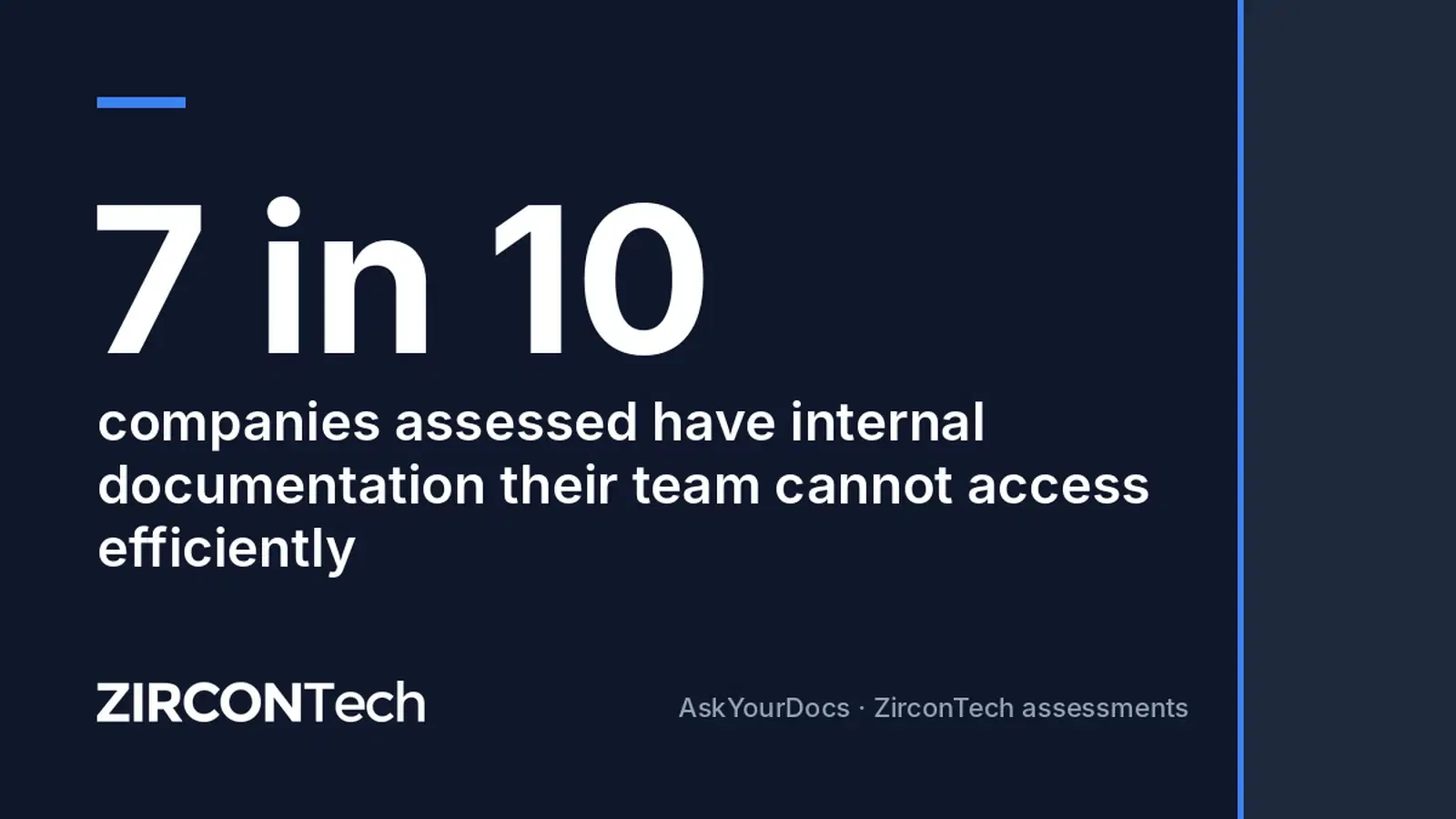
This scene plays out in wholesale distribution, logistics and retail with a regularity that surprises people once they measure it. Across the dozens of companies we have assessed in Uruguay, Argentina, Chile and the United States, question volume growing faster than the capacity to answer it was the single most common problem we documented. This article covers what that problem looks like, what it costs, what should change, and what we learned from solving it.
Volume grows faster than the team
The pattern is almost always the same. The company has 50 or more employees, a support team of 3 to 5 people, and more than 250 questions a month coming in over WhatsApp, phone and email. When the business grows, questions grow with it. The team does not. The first response is to ask the same people to handle more. The second is to hire, and that is where the ceiling appears: each new hire costs the same as the last one and resolves the same volume, so scaling support by headcount does not hold up.
In the meantime, four symptoms settle in. Repetitive questions, the “where is my order”, “do you have this in stock”, “what is the delivery window for my area” kind, eat the time the team should spend on cases that genuinely require judgment. Customers expect an immediate reply because that is how WhatsApp works, but the team covers 9 to 6. Nobody knows precisely how many questions come in each week, how many get resolved and how many get lost, because the channel is somebody’s personal phone or a shared account with no metrics. And every time a support person leaves, the answers that were never written down leave with them.
What stands out is not that the problem exists. It is that almost nobody has put a number on it. It is experienced as an operational nuisance, not as a cost.
What answering by hand actually costs
The math is short, and any operations manager can run it with their own numbers: repetitive questions per month, times the average time it takes to answer each one, times the team’s hourly cost. The result is the annual cost of avoidable manual support.
When we ran that calculation at distribution companies with 3 to 5 support people, the result landed between USD 15,000 and USD 40,000 a year, or USD 1,200 to USD 3,300 a month of team time spent answering the same thing over and over. At a software company we assessed, with 250 to 300 tickets a month and half of them repetitive, we documented USD 33,000 a year in avoidable support cost. It is worth being precise about what that figure is: a projection built from the company’s own data during the assessment, not a saving measured after implementation. It is evidence, but evidence of what the problem costs, not a promise of results.
That number also leaves out the hardest part to measure: the customers who do not come back. The cost of the team’s time shows up on payroll. The sale that went to another supplier at 7:40 on a Thursday shows up nowhere.
What should change: an answer in seconds, at any hour
The goal is not to remove human contact. It is for the customer to get an answer in seconds over WhatsApp, voice or web, at any hour, and for a person on the team to step in only when the question warrants it. Half of the questions a support team receives can be answered on their own. The other half is where the team adds value, and today it never gets there because it is busy with the first half.
In practice that means four components that adapt to how the team already works, not the other way around. A WhatsApp agent answers frequent questions automatically, around the clock, in the channel customers already use. A voice agent takes inbound calls and handles transfers without hold time. A knowledge base learns from the company’s internal documentation (catalog, delivery policies, commercial terms) so it answers accurately and consistently, instead of depending on what each person happens to remember. And a supervision dashboard shows in real time how many questions come in, how long they take to resolve and which ones need a human.
That last component is usually the one that changes the conversation with the operations manager, because for the first time support stops being a black box. You can see what customers ask, at what hours, what share gets resolved without intervention and where the team is still needed.
The human touch is not lost. It is concentrated. When the question is a complaint, a negotiation or an unusual case, the system hands it to a person with the full context of the conversation. Nobody has to explain from scratch again.
How we approach it
Every implementation follows ZirconTrace, a five-phase process that does not change by use case. Only the deliverables do.
- Diagnosis: agreed scope and metrics. Which questions get automated first, and how the result will be measured.
- Design: approved architecture on AWS, with the integrations needed into the order system, inventory or CRM.
- Build: solution ready for testing, with the knowledge base loaded with the company’s real documentation.
- Go-Live: in production, with the support team trained to supervise and correct answers.
- Operation: support, monitoring and continuous improvement driven by what the dashboard shows.
One design decision we have learned to defend: the first production version is deliberately narrow. It usually covers one channel (almost always WhatsApp) and the most frequent set of questions, and it reaches production in 6 to 8 weeks. We would rather the team see something real and measurable working than wait for a complete solution that covers everything from day one. The remaining components are added afterwards, on top of a base that has already proven itself with real customers.
What we saw across dozens of companies
The numbers that follow come from our own assessments, not from a market report. Each company assessed documents its problems and estimates the impact of each one with its own data.
78% of the companies we assessed had this problem, the most frequent one across the entire portfolio. 49% described it as critical because of the support volume it generates. And 62% chose this implementation as a priority over the other proposals in the assessment. The 1-in-2 repetitive question measurement showed up in both distribution and software companies, two industries that on paper look nothing alike and yet arrive at the same number.
The industries where we documented it include retail, distribution, logistics, software and SaaS, healthcare, energy and agribusiness. The pattern cuts across industries because the mechanism does: any business with customers who ask the same thing many times and a team that can only answer during office hours ends up in the same place.
It is also worth saying where this does not apply. If volume is low, a few dozen questions a month, the avoidable-cost math does not justify the project. If most questions require commercial judgment or negotiation, the automatable share is too small. And if internal documentation does not exist or is badly out of date, the first phase is to put it in order, not to build the agent. An assessment exists precisely to find this out before investing.
The technology, last
Up to this point there was no need to name a single service, and that is the point. Technology is the enabler, not the starting point. For whoever has to evaluate the solution technically: SupportAnywhere is built on Amazon Bedrock AgentCore for the conversational agent and its memory, Amazon Bedrock Knowledge Bases to answer from the company’s documentation, AWS End User Messaging for the WhatsApp channel, Amazon Connect for voice and transfers, and Amazon S3 to store the documentation.
We chose managed AWS services for a practical reason: the company does not have to operate models or infrastructure, pays for what it uses, and the solution scales with question volume without hiring anyone else. ZirconTech is an AWS Advanced Tier Partner, and the team that implements is made up of certified architects with production experience, not consulting experience alone.
The next step
If two of the four symptoms at the start of this article describe your operation, the avoidable-cost math is worth running with your numbers. The first step is a 60 to 90 minute diagnostic session to understand your company’s context, confirm whether this is the highest-impact case, and agree on how to measure it. That session can be funded through the AWS AI Assessment program, so getting started costs nothing.
Another year as things stand costs between USD 15,000 and USD 40,000 in team time, plus the customers who left without anyone logging it. Let’s talk this week.