Tuesday, 10:20. Someone on the sales team needs to know whether a client contract allows billing an additional service. The answer is in a 40-page PDF signed two years ago. They look on the shared drive, cannot find it, and ask on Slack. The only person who remembers where it is replies at 4 pm, after a morning of meetings. The next day, someone else on the same team asks the same question. And in two weeks, the person who remembered where the contract was starts at another company.
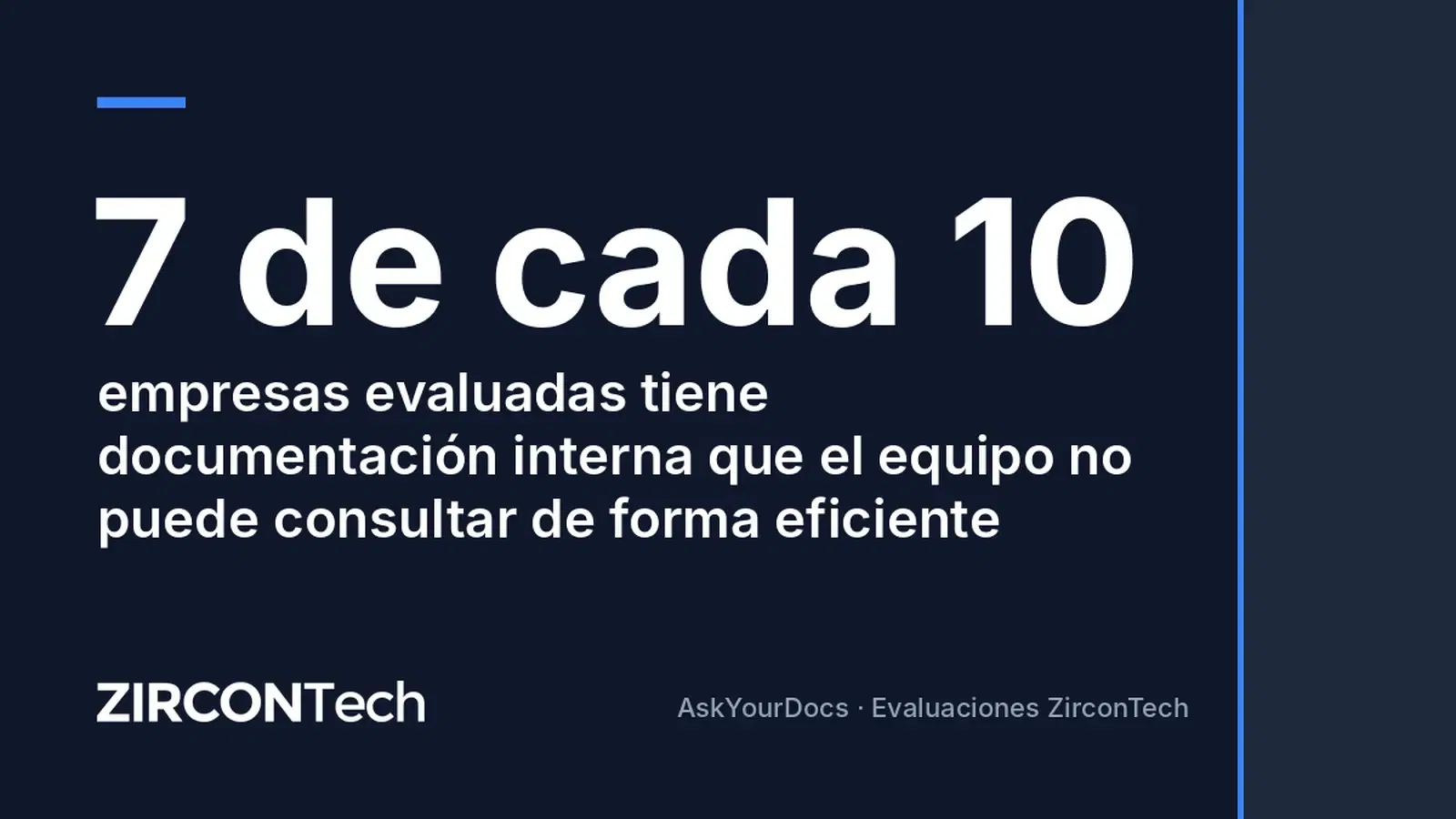
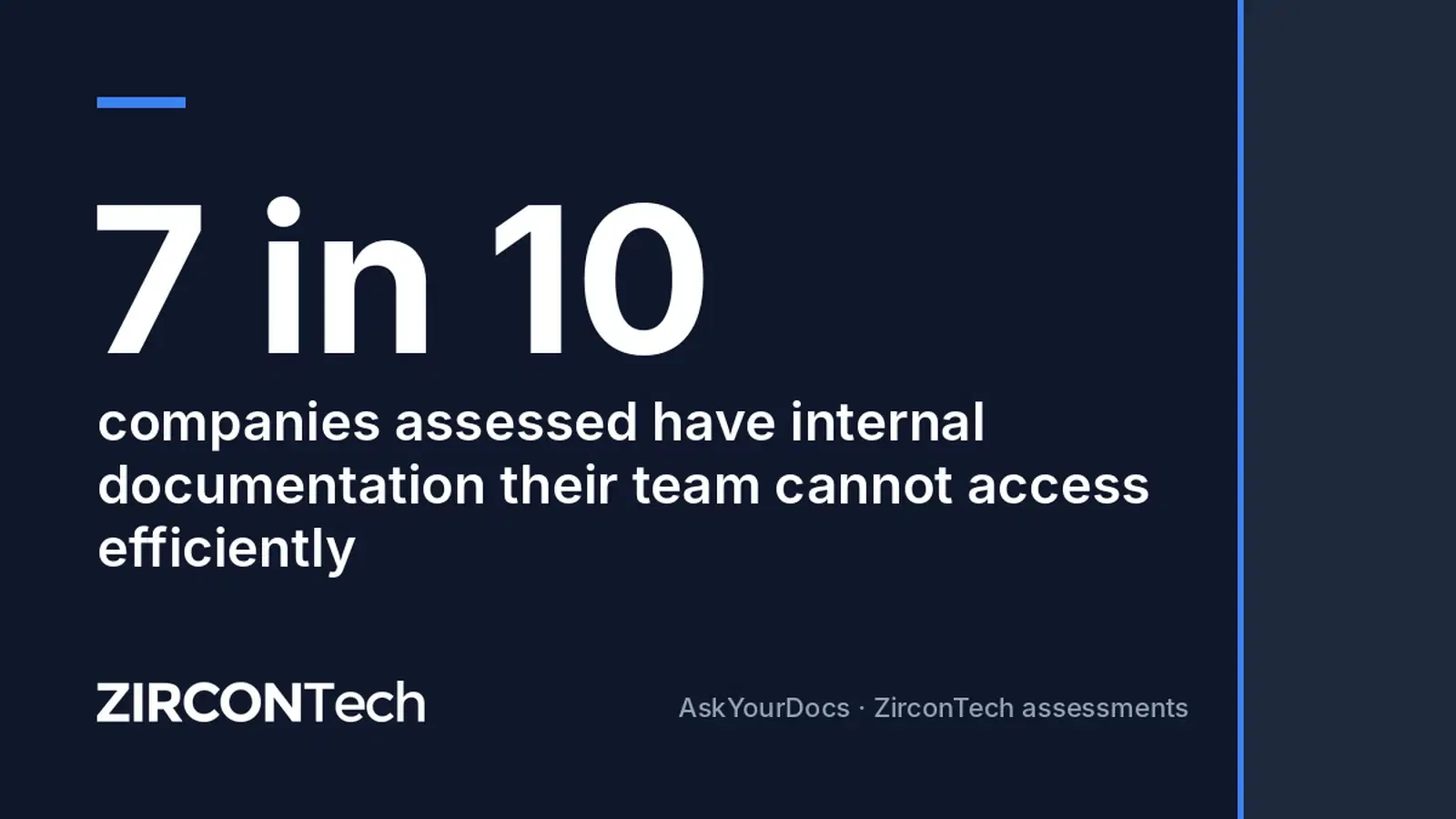
We saw this scene in almost every industry. Across the dozens of organizations we assessed in Uruguay, Argentina, Chile and the United States, 7 in 10 had internal documentation their teams could not consult without losing time. The information was there. What was missing was a way to reach it. This article covers what the problem looks like, what it costs, what changes when it is solved, and what we learned doing it.
The information exists, but it lives in folders and in people's heads
A company with years of operation has years of documentation: procedure manuals, internal policies, contracts, technical sheets, emails where something important was decided, a wiki someone built with enthusiasm and nobody updated afterwards. All of it is somewhere. The trouble is that "somewhere" means five different places, no search that works, and versions coexisting without anyone knowing which one is current.
The symptoms look much the same from one company to the next. The same questions come up on chat even though the answer is written down, because asking is faster than searching. The knowledge that matters lives in two or three people, and when they are out, everything stalls. A new hire takes weeks to get up to speed because nobody can explain where everything is. And contracts, manuals and procedures pile up in folders, emails and wikis with no way to consult them that does not depend on someone's memory.
Almost nobody has this quantified. It is lived as a daily annoyance. And when the person who knew where everything was leaves, they take with them a part of the company's knowledge that was never written down.
What it costs to search for what is already written
The math is short and any manager can run it with their own numbers: weekly hours each person spends looking for internal information, times the number of people on the team, times the hourly cost, times 50 weeks. The result is what the company pays each year to find what it already has in writing.
At a healthcare company we assessed, each Account Manager was losing 5 to 8 hours a week looking for client information spread across several documents. That is 20 to 32 hours a month per person, close to a full week of work. If in doubt, use 5 hours rather than 8. It is worth being clear about what that figure is: we measured it with the company's own data during the assessment. It is not a saving measured after implementation. It says what the problem costs, not how much will be recovered.
And it leaves out what is hardest to measure. Search time shows up in payroll. The decision made with an outdated version of a policy, the onboarding that took six weeks instead of two, or what the person who resigned knew, show up in no spreadsheet at all.
What changes: ask, and get the answer with its source
Nobody has to rewrite the documentation or learn another tool. Anyone asks in plain language, in the channel where they already work, and gets the answer right away along with the document it came from, so they can check it. Unlike a traditional search, the question does not have to use the exact words in the document: someone asking about "vacation" has to find the leave policy even if the file is named something else.
In practice there are four pieces. Ingestion processes PDFs, Word files, wikis and emails, the documentation that already exists, as it is. Semantic search finds answers even when the question is phrased differently. Access control defines which team can consult which information and keeps a record of who asked what. And integration puts the assistant where the team already is: Slack, Teams, the web or a custom interface.
The piece that carries the most weight with leadership is usually access control. The first objection to "an assistant that answers from all the company's documentation" is confidentiality: not everyone can see contracts, payroll or performance reviews. Without per-team permissions, the assistant is a risk. With permissions and auditing, each team consults what belongs to it, and there is a record.
With this, the company's memory stops depending on people. When someone leaves, what they knew stays available to whoever needs it. And whoever just joined can ask a hundred times without interrupting anyone.
How we do it
Every implementation follows ZirconTrace, a five-phase process that is the same for every use case. What changes are the deliverables.
- Diagnosis: priority sources and teams agreed. Which repositories go first, who consults them, and how the result will be measured.
- Design: architecture and access approved. Which team sees what, and how it is audited.
- Build: solution ready for testing, loaded with the company's documentation.
- Go-Live: in production, with the team trained to use it and to correct answers.
- Operation: support, monitoring and continuous improvement based on what people ask and cannot find.
One design decision we stand by: the first production version is deliberately scoped. It covers the repositories and teams prioritized in the diagnosis, not the company's entire documentation, and reaches production in 4 to 6 weeks. We would rather the team see the assistant working on their own documents than wait months for something that covers everything. The remaining sources are added later, on a base that has already shown it answers well.
What we saw across dozens of companies
These numbers come from our assessments, not from a market report. Each company assessed documents its problems and estimates the impact of each one with its own data.
70% of the companies assessed had internal documentation the team could not consult without losing time, across every industry in the portfolio. 46% described knowledge concentrated in a few people as an operational risk. And 79% of proposals of this kind were chosen as an implementation priority over the other proposals in the same assessment.
We found it in retail, distribution, logistics, software and SaaS, healthcare, energy and agribusiness. It repeats in very different industries because the mechanism is the same: years of accumulated documentation and a team that grows or turns over.
It is also worth saying where it does not apply. If there is little documentation and the team is small, asking the person next to you works and there is no cost that justifies the project. If the documentation is so outdated that the answers would be wrong, it has to be cleaned up first. And if the critical information was never written down, the assistant will not invent it: it has to be documented before. The assessment exists to know this before investing.
The technology, last
Up to this point there was no need to name a single service, and that is the idea. For whoever has to evaluate the solution technically: AskYourDocs is built on Amazon Bedrock AgentCore for the agent, its memory and the identity of whoever is asking, Amazon Bedrock Knowledge Bases to retrieve the relevant passages and answer citing the source document, Amazon S3 Vectors as the vector index, and Amazon S3 to store the documentation. The Slack, Teams and web integrations run through AgentCore Gateway.
We use AWS managed services for a practical reason: the company does not operate models or infrastructure, pays per use, and the solution grows with the volume of documents and questions. The documents never leave the company's own AWS account. ZirconTech is an AWS Advanced Tier Partner and the implementation team is made up of certified architects with production experience.
The next step
If two of the four symptoms at the start describe your organization, it is worth running the search-hours math with your numbers. The first step is a 60 to 90 minute conversation to understand your company's situation, see whether this is the highest-impact case, and look at the options for tackling it. In some cases the assessment can be funded through the AWS AI Assessment program; that conversation is where we find out whether it applies.